Why AI Education Should Begin in Grade 1
Published: February 23, 2026

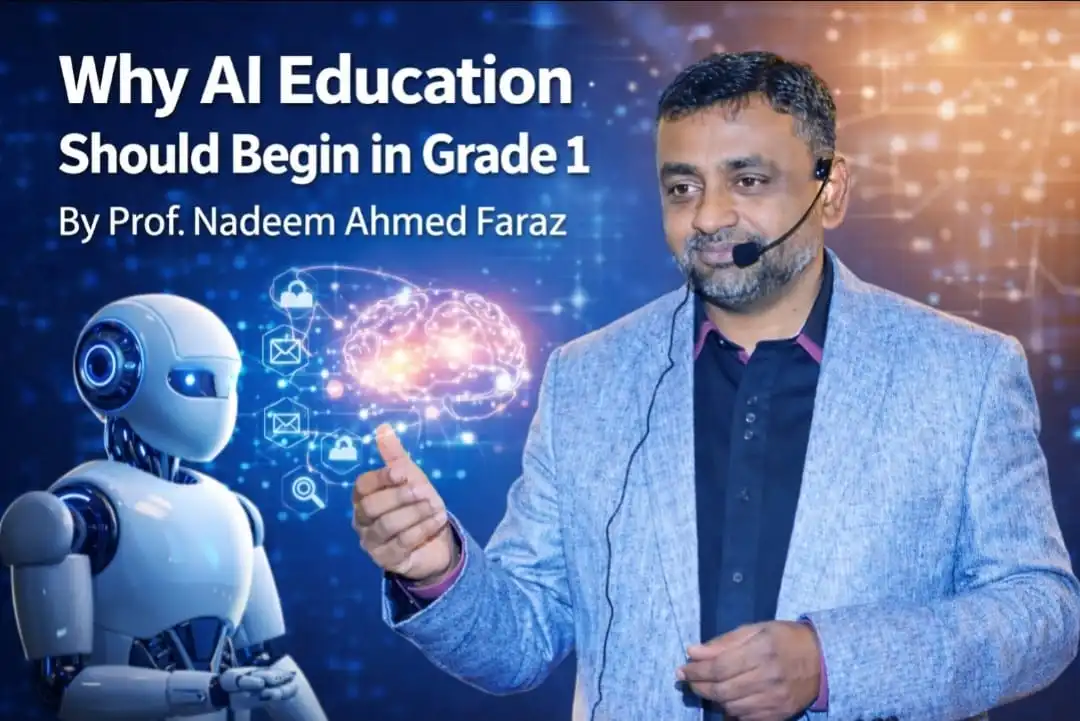
Why AI Education Should Begin in Grade 1
In an age where Artificial Intelligence (AI) reshapes every sector—from healthcare and finance to education and entertainment—it is no longer sufficient to teach AI only at higher grades. Introducing AI from Grade 1 empowers young learners with foundational skills that will define their future success.
Scientific research reveals that children as young as 5–7 years can grasp computational thinking, logical reasoning, and pattern recognition, the core building blocks of AI literacy (Bers, 2020). Early AI exposure strengthens executive functions like problem-solving, creativity, and adaptive thinking—skills linked with academic achievement and lifelong learning (OECD, 2021). Furthermore, adaptive AI-based learning tools increase engagement and can improve student performance by 20–40% compared with traditional instruction (Holmes et al., 2019).
Beyond technical skills, early AI education fosters ethical awareness, digital citizenship, and resilience in a data-driven world. Children learn to question how algorithms work, understand privacy and bias, and develop responsible decision-making—critical competencies in the 21st century (UNESCO, 2021).
AI is already part of children’s daily lives through smart assistants, personalized apps, and educational games. Formalizing AI learning from Grade 1 transforms passive users into confident creators, innovators, and critical thinkers. Starting AI education early is not just an educational enhancement—it is a strategic investment in humanity’s future.
References
- 🔗 Bers, M. U. (2020). Coding as a Playground.
- 🔗 Holmes, W., Bialik, M., & Fadel, C. (2019). AI in Education.
- 🔗 OECD (2021). Education and AI Report.
- 🔗 UNESCO (2021). AI in Education Framework.