Next-Generation Internet Infrastructure & Speed: Transforming the Digital Future
Published: April 1, 2026

Abstract
The global digital economy is entering a new era where speed, capacity, and reliability of internet infrastructure are becoming central to economic growth, innovation, and governance. Recent advancements by Nippon Telegraph and Telephone (NTT) in multicore optical fiber (MCF) technology demonstrate how next-generation infrastructure can increase data transmission capacity by up to 400% without altering existing cable dimensions. This breakthrough signifies a paradigm shift in how data networks will evolve over the next decade.
Keywords
Multicore Optical Fiber, Next-Generation Internet, Digital Infrastructure, High-Speed Connectivity, Spatial Multiplexing, Data Transmission, Global Digital Economy, Fiber Optics, 5G, 6G
1. Introduction
The global digital economy is entering a new era where speed, capacity, and reliability of internet infrastructure are becoming central to economic growth, innovation, and governance. Recent advancements by Nippon Telegraph and Telephone (NTT) in multicore optical fiber (MCF) technology demonstrate how next-generation infrastructure can increase data transmission capacity by up to 400% without altering existing cable dimensions. This breakthrough signifies a paradigm shift in how data networks will evolve over the next decade.
2. Technical Background
Unlike traditional single-core fiber systems, multicore optical fibers utilize spatial multiplexing, allowing multiple independent data streams within a single fiber. This innovation not only enhances bandwidth but also reduces the need for extensive infrastructure overhauls. Such compatibility with existing systems makes it a cost-effective and scalable solution for both developed and emerging economies.
3. Implications for Digital Economy
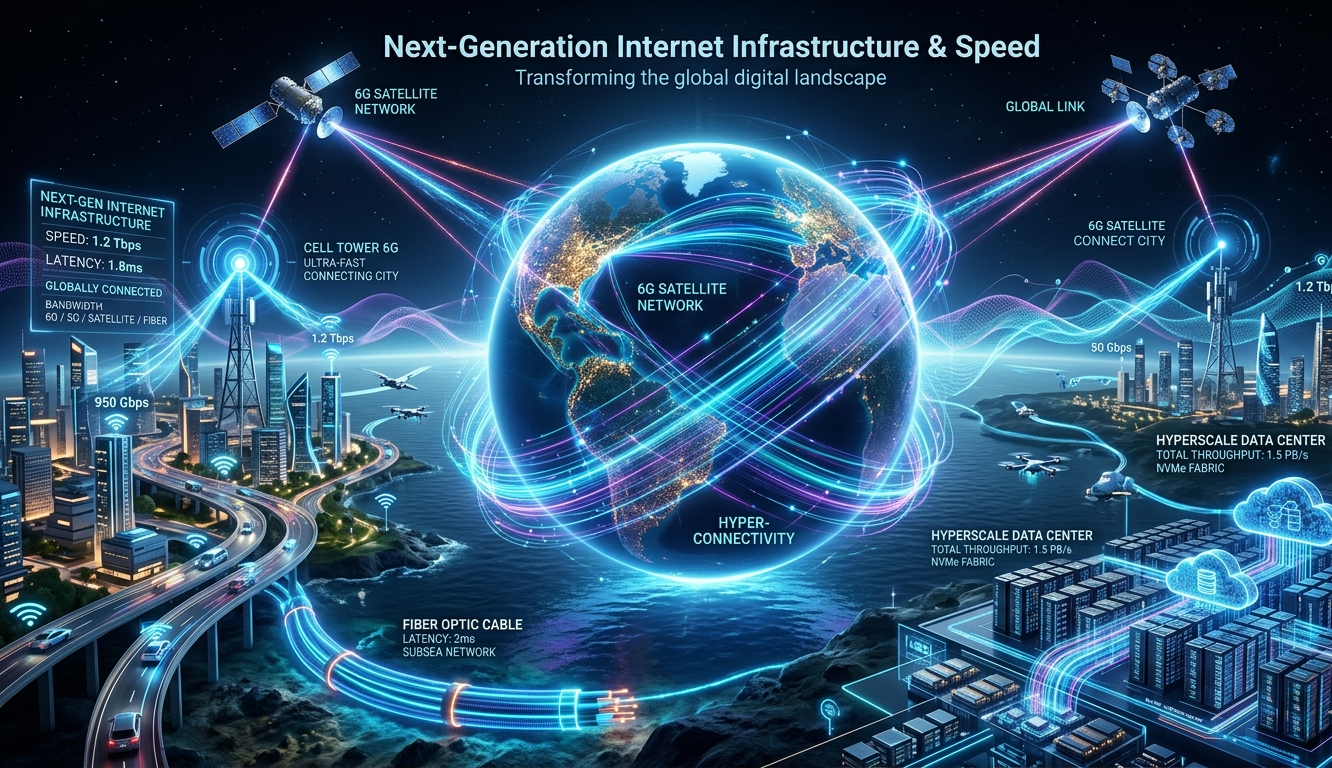
The implications of next-generation internet infrastructure extend beyond speed improvements. It directly enables the expansion of Artificial Intelligence, cloud computing, 5G/6G networks, and real-time data analytics. For countries like Pakistan, this transformation presents a strategic opportunity to strengthen digital connectivity, boost IT exports, and empower a knowledge-based economy.
4. Challenges and Requirements
However, realizing these benefits requires proactive policy frameworks, investment in fiber optic networks, and capacity-building in digital skills. Governments and institutions must prepare for infrastructure upgrades and align with global telecom advancements to remain competitive.
5. Future of Digital Systems
The evolution of high-speed infrastructure is essential for future learning ecosystems. Digital education, remote work, telemedicine, and smart governance systems rely heavily on stable and high-capacity internet networks. Governments must therefore align national strategies with global technological advancements to remain competitive in the digital age.
6. Conclusion
In conclusion, next-generation internet infrastructure is not merely a technological upgrade but a foundational pillar for economic transformation and sustainable development. Countries that invest early in advanced connectivity solutions will lead the future digital economy.
7. References
- Nippon Telegraph and Telephone (2026). Multicore Optical Fiber Technology Report.
- International Telecommunication Union (2023). Global Connectivity Report.
- World Bank (2024). Digital Development Overview.
- OECD (2023). Broadband and Digital Infrastructure Outlook.