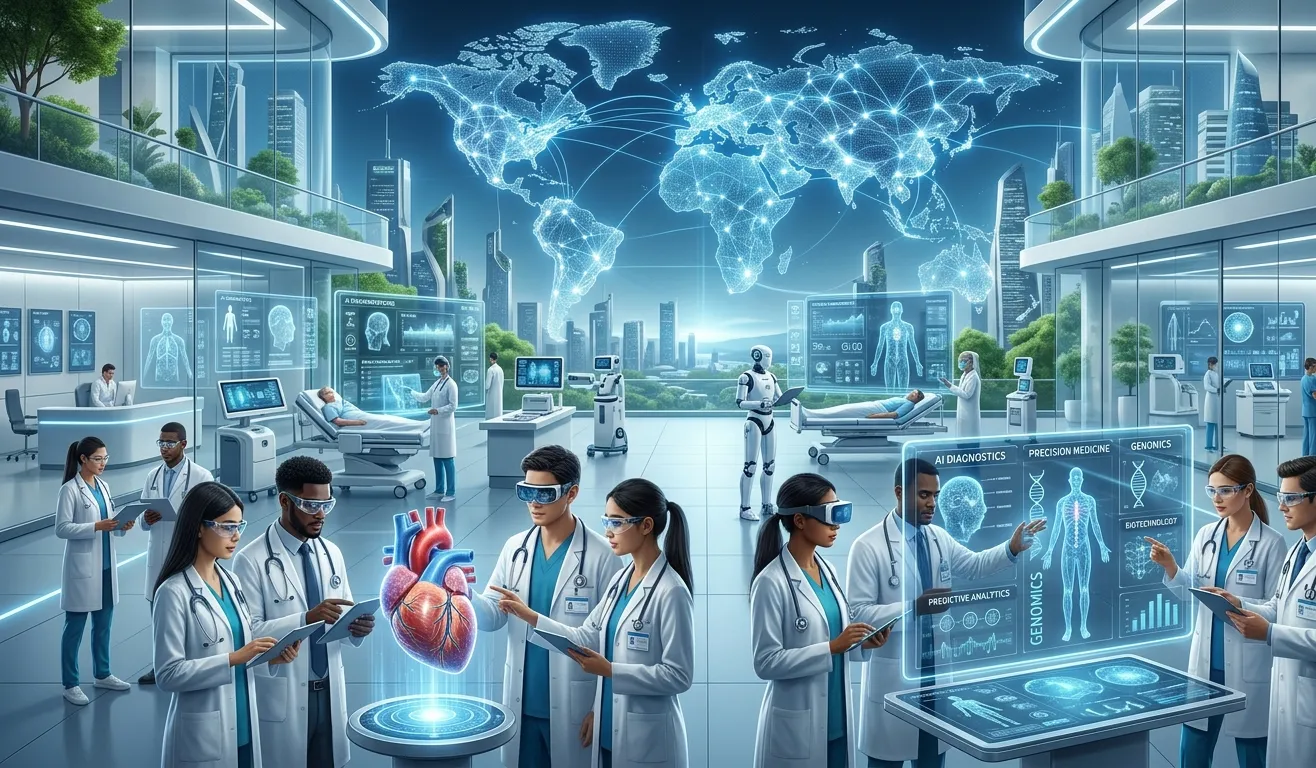
Beyond 2030: The Future of Health Management and Health Sciences Education in the Age of Artificial Intelligence
Published: June 9, 2026
Practical Application of Bloom’s Taxonomy in Future Learning: A Step-by-Step Tutorial Guide for Educators
Introduction
In the era of Artificial Intelligence, digital transformation, and future economies, educators must go beyond traditional teaching methods. Bloom’s Taxonomy, developed by Benjamin Bloom, provides a powerful framework to transform classrooms into centers of critical thinking, innovation, and real-world problem solving.
This tutorial guide enables teachers and educationists to practically apply Bloom’s Taxonomy in modern classrooms aligned with Future Learning principles.
Step 1: Start with Clear Learning Objectives
Design learning objectives across all six cognitive levels:
- Remembering: Recall facts, definitions, and concepts.
- Understanding: Explain ideas and interpret information.
- Applying: Use knowledge in practical situations.
- Analyzing: Examine relationships and break down information.
- Evaluating: Make judgments based on evidence and criteria.
- Creating: Generate new ideas, solutions, and innovations.
Future Learning Insight: Modern education should place greater emphasis on higher-order thinking skills—Analyzing, Evaluating, and Creating—to prepare learners for AI-driven and innovation-based environments.
Step 2: Design Smart Classroom Activities
Transform traditional lessons into engaging learning experiences:
- Interactive quizzes and flashcards for Remembering.
- Group discussions and concept mapping for Understanding.
- Case studies and simulations for Applying.
- Research and data interpretation tasks for Analyzing.
- Debates and peer reviews for Evaluating.
- Innovation projects and design challenges for Creating.
Integrating digital technologies, AI-powered learning tools, and collaborative platforms can significantly enhance student engagement and learning outcomes.
Step 3: Shift from Teaching to Facilitation
Future-ready educators must serve as facilitators, mentors, coaches, and innovators rather than merely information providers. Inquiry-based learning, collaborative problem solving, and creative exploration should become central components of classroom practice.
Step 4: Align Assessment with Thinking Levels
Traditional examinations primarily assess memory and recall. Future-oriented assessments should evaluate students’ ability to think critically, solve problems, and create innovative solutions.
- Project-based learning assessments.
- Real-world problem-solving activities.
- Critical thinking and analytical tasks.
- Innovation and entrepreneurship projects.
- Digital portfolios and reflective learning journals.
Step 5: Integrate Future Learning Skills
Bloom’s Taxonomy should be integrated with essential twenty-first century competencies, including:
- Artificial Intelligence and Digital Literacy.
- Critical Thinking and Problem Solving.
- Emotional Intelligence and Leadership.
- Entrepreneurial and Innovative Thinking.
- Global Citizenship and Cultural Competence.
- Communication and Collaboration Skills.
This holistic approach ensures students become adaptable, innovative, and future-ready leaders capable of thriving in rapidly evolving global environments.
Conclusion
Bloom’s Taxonomy is no longer merely an educational theory; it is a strategic framework for transforming teaching and learning in the twenty-first century. When aligned with Future Learning principles, it empowers educators to develop critical thinkers, creative problem solvers, and lifelong learners.
By adopting this approach, educational institutions can better prepare students for leadership roles in 2030, 2040, and beyond.
“The goal of education is not to fill minds with information, but to develop thinkers, creators, innovators, and leaders.”
References
- Bloom, B. S. (1956). Taxonomy of Educational Objectives: The Classification of Educational Goals.
- Anderson, L. W., & Krathwohl, D. R. (2001). A Taxonomy for Learning, Teaching, and Assessing.
- UNESCO (2023). Future of Education Report.
- World Economic Forum (2024). Future of Jobs Report.
- OECD (2023). Education 2030 Framework.
- Partnership for 21st Century Learning (P21). Framework for 21st Century Learning.