Agroforestry – Students as Environmental Sustainability Managers
Published: January 29, 2026
Abstract
Climate change has emerged as one of the most severe global challenges of the 21st century, threatening food security, ecological balance, and human survival. According to the Intergovernmental Panel on Climate Change (IPCC), agriculture, forestry, and land use contribute nearly 24% of global greenhouse gas emissions, while simultaneously holding immense potential for mitigation through nature-based solutions. Agroforestry — the deliberate integration of trees with crops and livestock — is internationally recognized as a powerful, low-cost, and scalable climate solution. The Food and Agriculture Organization (FAO) reports that agroforestry is practiced on over 43% of the world’s agricultural land, supporting the livelihoods of more than 900 million people. Scientific studies confirm that agroforestry systems can sequester 0.5 to 5 metric tons of carbon per hectare per year, while improving soil fertility, biodiversity, and farm resilience. This article emphasizes the strategic role of students as Environmental Sustainability Managers, capable of accelerating agroforestry adoption and driving long-term climate resilience through education, leadership, and action.
Article
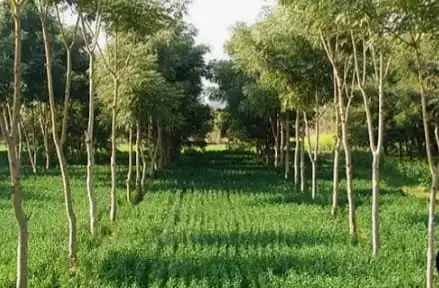
The climate crisis demands solutions that are practical, inclusive, and future-oriented. Agroforestry stands at the intersection of environmental restoration, food security, and economic sustainability. By combining trees with agricultural systems, agroforestry enhances carbon sequestration, stabilizes soils, improves water retention, and moderates microclimates. Research demonstrates that agroforestry systems can increase total carbon stocks by over 100% compared to monocropping systems, while simultaneously improving farm productivity and biodiversity.
In developing countries like Pakistan, where agriculture is the backbone of the economy and climate vulnerability is high, agroforestry offers a transformative pathway. Trees integrated into farms reduce dependence on chemical fertilizers, lower production costs, and provide diversified income sources through fruits, timber, fodder, and fuelwood. These benefits strengthen rural livelihoods while contributing to national climate commitments.
Students represent a powerful yet underutilized force in environmental sustainability. When engaged as Environmental Sustainability Managers, students move beyond theoretical learning into applied climate leadership. School-based agroforestry projects, community nurseries, and plantation drives enable students to develop skills in environmental monitoring, data collection, teamwork, and project management. Such experiential learning cultivates responsibility, innovation, and a deep sense of environmental stewardship.
Empowering youth to lead agroforestry initiatives transforms educational institutions into living laboratories of sustainability. Students do not merely plant trees; they plant resilience, hope, and solutions for future generations.
Reflection
Agroforestry is not merely an agricultural technique — it is a mindset of harmony between humanity and nature. When students take ownership of environmental sustainability, they evolve into conscious leaders of change. Every tree planted by a student today is an investment in cleaner air, fertile soil, food security, and a climate-resilient tomorrow. The future of our planet does not rest solely in policies and technologies, but in the hands of informed, inspired, and action-driven youth.
References
- Intergovernmental Panel on Climate Change (IPCC). (2023). Climate Change 2023: Synthesis Report. Geneva: IPCC.
- Food and Agriculture Organization of the United Nations (FAO). (2022). Agroforestry for Sustainable Agriculture and Climate Change Mitigation. Rome: FAO.
- FAO & World Bank. (2021). Nature-Based Solutions for Climate-Smart Agriculture. Washington, DC.
- Nair, P. K. R., et al. (2020). Carbon Sequestration in Agroforestry Systems. Forests, 11(2).
- Jose, S. (2019). Agroforestry for Ecosystem Services and Environmental Benefits. Agroforestry Systems, 93.
- Government of Pakistan, Ministry of Climate Change. (2021). National Climate Change Policy. Islamabad.

By Prof. Nadeem Ahmed Faraz